Helically Symmetric Experiment
The Helically Symmetric Experiment (HSX) is an advanced stellarator fusion research device operated by the University of Wisconsin–Madison, located in Engineering Hall. Designed to investigate innovative approaches to magnetic confinement, HSX uses a unique quasi-helically symmetric magnetic field configuration to improve plasma confinement and reduce energy losses commonly found in conventional stellarators. The device utilizes a series of complex three-dimensional coils arranged around a toroidal vacuum vessel to generate magnetic fields capable of confining plasma at temperatures exceeding 10 million degrees Celsius. HSX serves as an important platform for studying the physics needed to support future fusion energy systems.
PSL’s Contributions
PSL played a key role in the development of HSX, providing engineering expertise throughout the design, analysis, fabrication, and construction phases of the project. PSL assisted in the development of the magnetic coil systems, vacuum vessel, and overall machine assembly, helping transform a complex scientific concept into a functioning experimental facility. The project required close coordination between engineers, fabricators, and researchers to ensure the precise construction and alignment of the device’s highly specialized components.
Scientific Impact
HSX is the only stellarator in the world designed with quasi-helical symmetry, making it a unique tool for studying plasma transport, confinement, and stability. Research conducted on the device has advanced the understanding of magnetic confinement physics and helped guide the design of next-generation stellarators and future fusion power concepts.
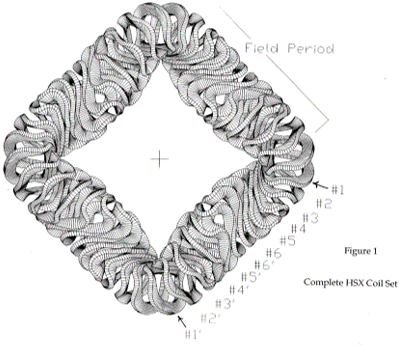
HSX Drawing
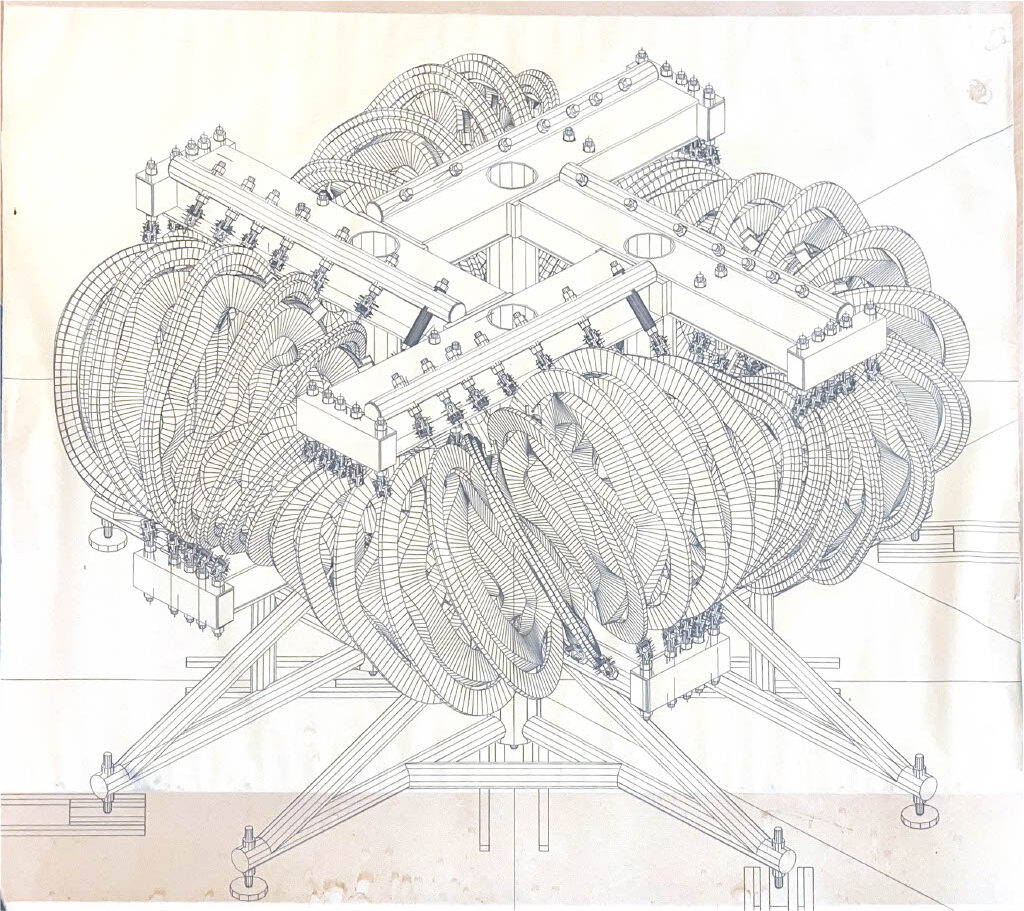
CAD Drawing of HSX coils in full assembly, illustrating four-fold symmetry in coil layout.
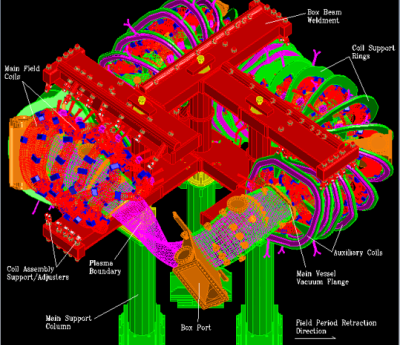
HSX assembly drawing
Historic assembly drawing of HSX as built.
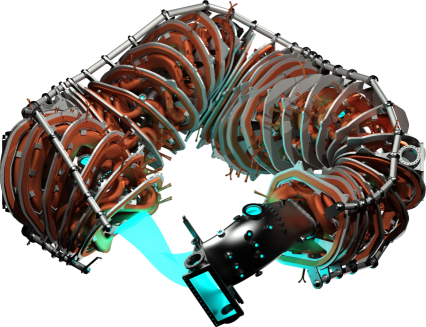
CAD Drawing
CAD drawing of the HSC stellarator. Credit to the HSX website.
On Paper Model
A model printed on paper. Come see this great image at PSL!