LZ
LUX-ZEPLIN (LZ) is a large-scale dark matter experiment designed to detect some of the rarest interactions in the universe. Located nearly a mile underground at the Sanford Underground Research Facility (SURF) in Lead, South Dakota, LZ uses seven tonnes of purified liquid xenon as its primary target to search for evidence of dark matter particles.
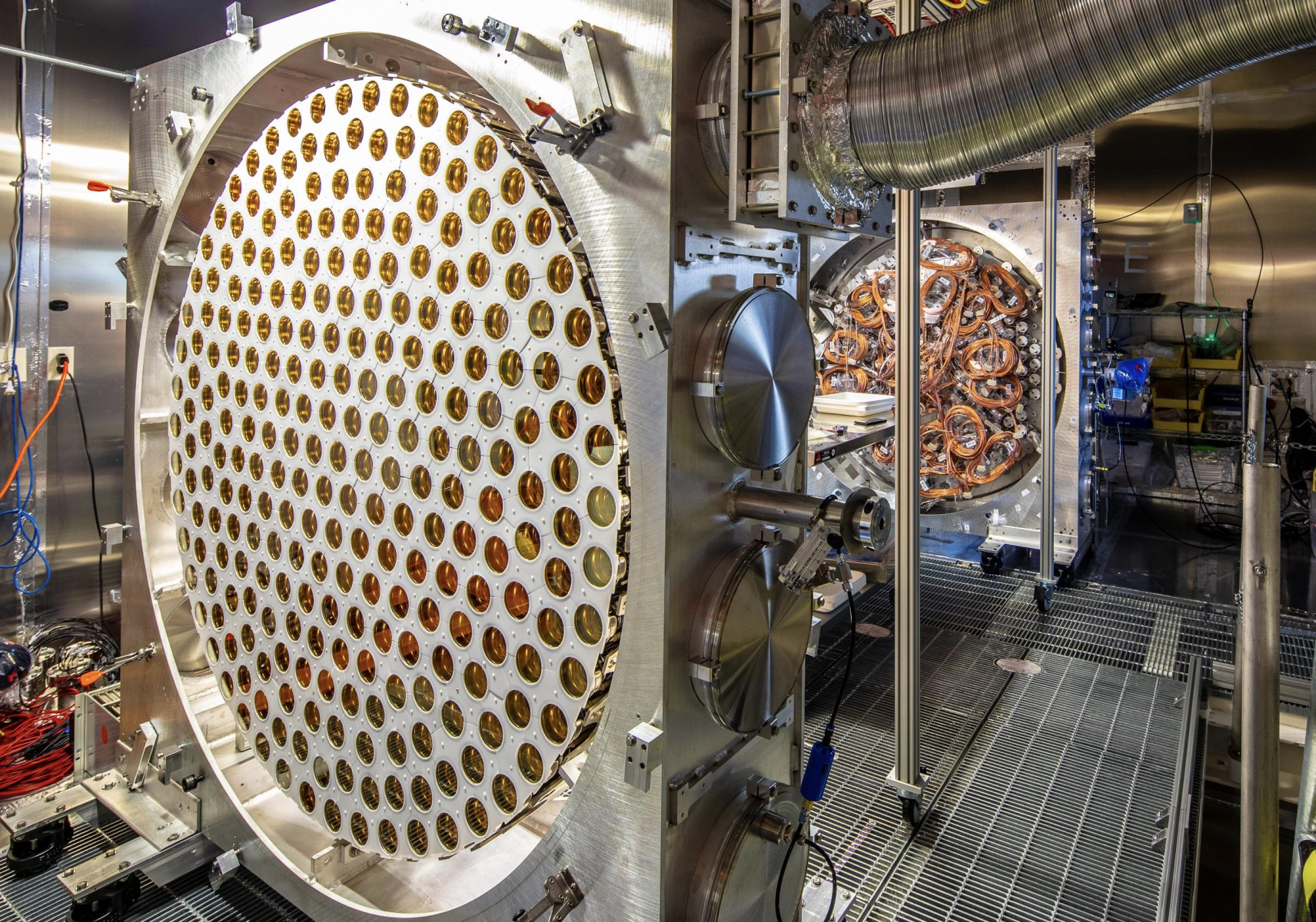
At the center of LZ is a dual-phase time projection chamber (TPC) containing the liquid xenon target. When a particle interacts with a xenon atom, it can produce a tiny flash of scintillation light and a second signal from ionization electrons extracted into gaseous xenon. LZ detects these signals with 494 low-background photomultiplier tubes positioned above and below the active xenon volume. The timing and distribution of the two signals allow researchers to reconstruct where an interaction occurred and distinguish potential dark matter events from background radiation.
The detector is surrounded by multiple layers of shielding and active veto systems designed to eliminate unwanted background events. A thin instrumented layer of liquid xenon surrounds the central target, followed by a gadolinium-loaded liquid scintillator Outer Detector that helps identify neutrons and other background particles. The entire detector is immersed in approximately 230 tonnes of ultrapure water, providing additional passive shielding from radiation and a means of detecting cosmic-ray muons. Together, these systems allow LZ to operate in an exceptionally low-background environment.
The experiment is located 4,850 feet underground in the former Homestake gold mine. The depth is essential to the experiment: the surrounding rock greatly reduces the flux of cosmic rays that could otherwise overwhelm the extremely rare signals LZ is designed to detect.
LZ is now operating as a science experiment and has produced increasingly sensitive dark matter searches. Its results have placed world-leading constraints on dark matter interactions, while its data are also being used to study other rare physical processes. Recent analyses have extended the experiment’s reach to lighter dark matter and have provided evidence for coherent elastic neutrino-nucleus scattering from solar neutrinos, demonstrating LZ’s ability to detect extremely small energy deposits in liquid xenon.
PSL’s Contributions
PSL has supported LZ through engineering, fabrication, clean assembly, and specialized instrumentation for the detector. The project requires components and systems capable of operating in an exceptionally clean, low-background environment, where even trace contamination or unwanted radioactive material can interfere with the experiment’s measurements.
PSL’s clean assembly facilities have been used for clean cable assembly for LZ as well as clean assembly of the xenon gas-handling system. These systems require careful control of particulate contamination and attention to cleanliness throughout fabrication and assembly. PSL’s clean assembly space can achieve particle levels of Class 10,000 (ISO 7) or better with appropriate gowning and cleaning procedures.
Through its engineering and manufacturing capabilities, PSL has contributed to the specialized hardware and infrastructure needed to support LZ. This work draws on PSL’s experience with precision fabrication, electrical and mechanical systems, clean assembly, instrumentation, and the integration of complex scientific equipment.